Canon EOS R6 Mark III – A Hands-On Review

First impressions of the Canon EOS R6 Mark III
Today sees the launch of Canon EOS R6 Mark III, the latest addition to Canon’s mirrorless EOS R series of cameras. This is an update to the popular Canon EOS R6 Mark II and sees a big improvement in resolution as well as some great new additions that are going to make this a very popular camera, especially at the very competitive price of £2,799.
I had the opportunity to test the camera before its release, and today I’ll be sharing my thoughts, and some images, here on my blog.

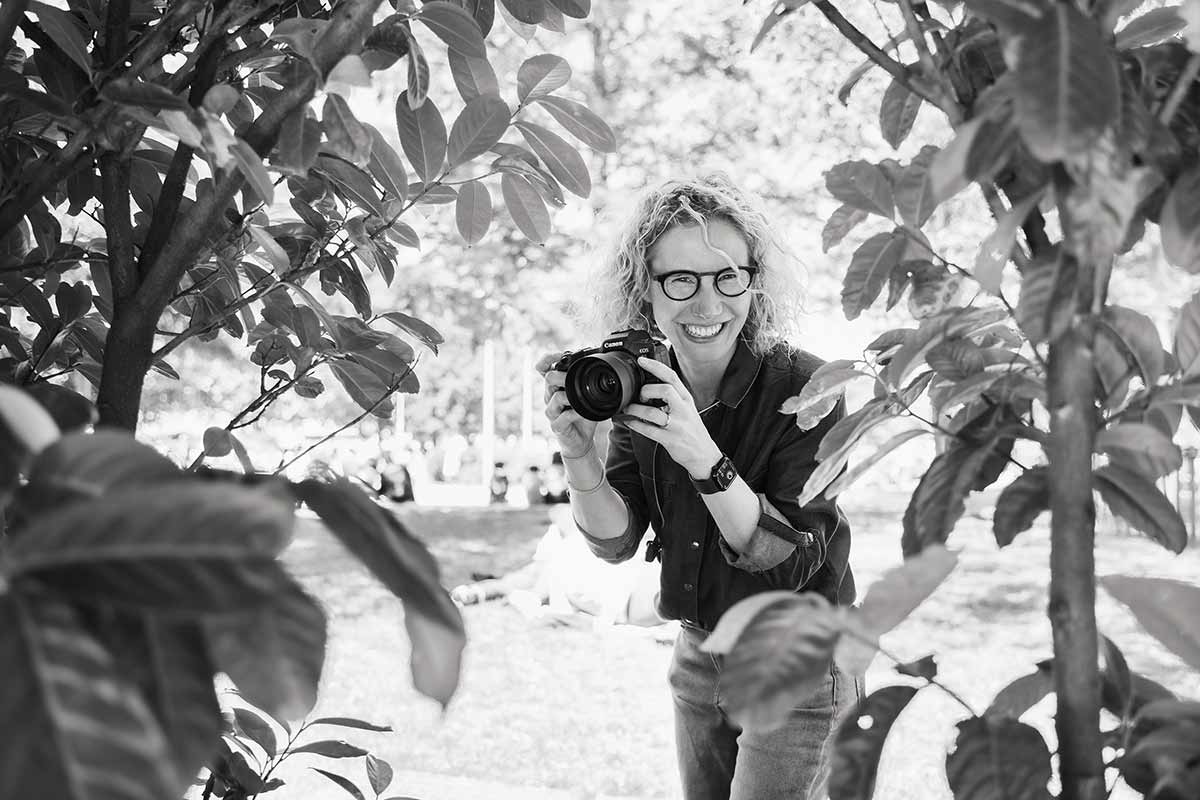
First though, to introduce myself. I’m Helen Bartlett, a family photographer based in London and a Canon Ambassador since 2018. My work is baby, children, and family portraits, all taken in monochrome and photographed on location at my clients’ homes and places they like to go such as the park and the woods. To test the Canon EOS R6 Mark III, I did three family photo shoots, working in my normal way to see how the camera performed when photographing fast moving children having fun.
I looked at what the camera was like to use: Is it intuitive? How does it feel in the hand? And of course, how does it perform? I looked at the autofocus and how it compared with my Canon EOS R5 Mark II, testing how the camera would cope in low light with a wriggly baby playing hide and seek under a blanket. Real world scenarios like these give you a sense of how the camera could perform for you and your photography.
The pictures on this blog are taken with the EOS Canon R6 Mark III using pre-production hardware and firmware. If you enjoy the blog and are keen to purchase a Canon R6 Mark III, I have an affiliate link set up with WEX that you can find here, and again at the bottom of this blog post.

The Canon EOS R6 Mark III – what’s new?
Replacing the Canon EOS R6 Mark II and bringing some of the Canon EOS R5 Mark II’s high-end features down to a much more accessible price point, the Canon EOS R6 Mark III is a very impressive camera. It boasts a 32.5 megapixel sensor, upgraded from the Mark II’s 25.6 megapixels, giving you the opportunity to make bigger prints, or crop in further, which is so useful in all genres of photography when there is a print as the final outcome.
High speed shooting is impressive with a frame rate of 40 fps on the electronic shutter or 12 fps on the mechanical shutter. Combined with the new feature of pre-continuous shooting, this opens up many new opportunities to us as photographers as I’ll discuss below.
Autofocus has been improved with Dual Pixel CMOS AF II and deep learning – the camera can track people, animals, trains and planes and works brilliantly to keep eyes in focus as children leap around in excitement. As the camera takes over more of the legwork with these amazing upgrades it means that as photographers we can concentrate more on composition and light and finding different and unique ways to take our pictures without having to worry about whether it will be in focus. This creative freedom is sure to spur innovation – I love the fact that now I can hold my camera above my head, using the fold out screen to see the scene, and concentrate on composition knowing that the camera is tracking the action.
There are new video options which I have not explored (regular readers will know I only work in stills!) but you can find out more about these features and their benefits on the Canon website.
As well as these big headline improvements there are lots of little changes and features which make our lives easier, from the “send to smartphone” button to my favourite, the ability to save your camera settings to a card and restore them later on.
So let’s dive in and take a proper look at the Canon EOS R6 Mark III.


Image Quality on the R6 Mark III
Let’s start with image quality as this is so important. The camera could be the best in the business but if the images aren’t big enough for your needs then it’s not the right tool for the job. The images from the R6 Mark III will be perfect in most scenarios unless you need to print very big indeed.
The camera has a 32.5 megapixel full-frame dual pixel CMOS AF II sensor with in-body image stabilisation of up to 8.5 stops (depending on which lenses are being used). This means sharp shots at slow shutter speeds are possible, giving new opportunities for working with movement.


I am used to the 45 megapixel files from the Canon EOS R5 Mark II and I have to say I was really impressed with the files from the R6 Mark III. The dynamic range is great and the files look brilliant on my 27” Studio Display screen. For photographers who like to crop then having the extra resolution makes this a great upgrade from the R6 Mark II’s 25.6 megapixels.
For photographers who have been using older cameras with 30 megapixel sensors, such as the EOS 5D Mark IV or the EOS R, the R6 Mark III is going to be a huge upgrade in terms of features with no loss of resolution. It’s a great time to make the move to mirrorless for photographers who have been photographing with the 5D system!
High ISO performance is really good. I didn’t have the opportunity to work in really low light but photographing at ISO 5000 the results have been very good, and I’d be very confident photographing families indoors at this level on a winter family photo shoot.

Canon EOS R6 Mark III autofocus
For many photographers, myself included, then autofocus is one of the first thing we really look at with a new camera. Over the past few years, the technology in this area has come on so fast allowing us to create images I could only have dreamed of when I started my business 23 years ago. Images that were once a real feat of craft and timing are now commonplace thanks to these amazing machines. I love that the new technology allows me to push my work forward, to try new things, and create more interesting images.
Here’s the technical information: the Canon EOS R6 Mark III offers Dual Pixel CMOS AF II and deep learning autofocus. It can recognise people, animals, vehicles, planes and trains as subjects and it also knows where on those subjects to focus, specifically eyes and heads. What does that mean in practice? That it’s a dream to use and that child running erratically across the field and then leaping off a fallen tree will be in focus even when working with a wide aperture. We can capture the action and blur out the pesky other park users in the background, it’s brilliant.


The R6 Mark III has the same options for selecting the AF area as the R5 Mark II, so it was very instinctive to me. I like to assign selecting the AF area to the quick control dial on the back of the camera so I can shift from spot focus to a large area of focus very quickly.
If you are new to this system, you will see there are some AF areas that have a little padlock on them: these do not track and so you will want to use those if you are shooting landscapes or still life. The other AF areas will track automatically following your subject with pinpoint accuracy. It is, of course, easy to move the focus point from one person to the other to ensure your preferred subject is the one that is tracked.
I found the tracking to lock on really well even when photographing children running around and in between obstacles such as foliage or bubbles.


Registered People Priority
To make focus tracking easier the R6 Mark II also offers Registered People Priority which is another feature familiar to users of the R5 Mark II. This means if you have a particular person you want the camera to prioritise, you can take an image of them at the beginning of your photo shot and assign them as a registered person. Alternatively, you could use a picture they have sent you in advance which works equally well. This could be useful for prioritising the bride and groom at a wedding or I use it to prioritise the birthday child and their siblings if I am photographing a birthday party.
Servo AF can be in either automatic or manual – I like to use mine in manual and have the Servo AF characteristics set to -1 on tracking sensitivity which works well for photographing fast moving kids.
I found the autofocus on the R6 Mark III to be incredibly responsive. It didn’t feel quite as fast and accurate as the R5 Mark II but, if I didn’t know that camera as well as I do, I wouldn’t have noticed any shortfall at all. It’s very impressive, and didn’t struggle with some of the situations that I feel can confuse cameras such as heavily backlit scenes with small subjects and dappled light where it focused quickly and accurately.
I’d be confident photographing families in any scenario with this camera.


Hi Speed and Pre-Continuous shooting on R6 Mark III
Pre-continuous shooting is one of my favourite features on the Canon EOS R5 Mark II and so I was thrilled to see it included in the feature line up for the R6 Mark III.
Pre-continuous shooting is a setting where, when it is enabled, as you half press the shutter the camera starts to record images to the buffer but only records them to the card when you fully press the shutter. In effect this means the camera has started taking pictures before you fully press the shutter button and it can record a moment that you would otherwise have missed.
I love to use this setting for things like games of Jenga when I want to catch the moment the pieces fall, or children doing acrobatics or jumping out from somewhere, activities where I know something is about to happen but I don’t know when and by the time I realise it’s happening I might have missed it – children are lightning fast, especially when they do something amazing.


Pre-continuous shooting is, of course, one of those settings where you can end up taking a lot of pictures very quickly and filling your memory cards. Personally, I’ve found it works well to assign pre-continuous shooting, and the fast shutter speed I want to use with it, to a custom mode so I can jump to it, and off it again, as the action dictates. Otherwise, you can find pre-continuous shooting in the Q menu but it’s a faff to go in there, find it, enable it, take your pictures and then turn it off again, much quicker to have it at the turn of a dial to a custom function.
The Canon R6 Mark III also offers a great continuous shooting speed of 40 fps with the electronic shutter or 12 fps with the mechanical shutter, so you can photograph every part of a moment and choose the best picture later. As you can imagine, in conjunction with the pre-continuous shooting this is a very powerful feature giving us great opportunities for creativity and for finding the perfect combination of action and expression.


Body and Handling
The R6 Mark III will feel instantly familiar to users of Canon’s mirrorless system and I found it very intuitive to use. I didn’t notice any significant difference in weight to my R5 Mark II, it’s a camera I could easily carry around all day.
Bringing it into line with the Canon EOS R5 Mark II, the R6 Mark III uses the new LP-E6P battery which I have found to be long lasting and fine for a full morning family photo shoot, wedding photographers would want a couple of batteries for a full day of continuous shooting and, as always with anything important, it’s always good to have a spare. The R6 Mark III has dual card slots with one for the CF Express cards and the other for standard SD cards – giving the option to shoot RAW to the CF Express and a jpeg back up to the SD card which is an important feature for wedding photographers. When testing I used CF Express cards with a read speed of 1700 MB/s and a Write speed of 1200 MB/s which worked very well when working with fast frame rates and pre-continuous shooting.
For video users there is a switch for movie to stills on the top left of the camera body and there’s also a button to rate your images or assign a colour to them to make them easier to find later. This could be useful for wedding photographers who like to make a quick selection during the meal, or for corporate photographers who need a lightning fast turnaround enabling them to make their first selections while still out on the job.


Custom Modes and Saving your Settings
Custom modes are changed via the dial on the top by the shutter button which I found a bit more fiddly than my R5 Mark II where I have assigned this the M-Fn button. But, I’m sure I’d get used to the dial given time.
On the plus side, one of my favourite features on the R5 Mark II is now available for the first time in an R6 body and this is the ability to save your settings to a card.
This might not seem like the most exciting feature but trust me when I say it is. I have a folder on my computer where I keep a copy of all my camera settings: I have my standard settings, but also those I use less regularly like those for underwater photography. I can put both of these onto a card and so during a shoot I can switch between my standard settings and my swimming settings without needing to remember all the details of what needs to be changed. Previously I had a note set up on my phone with all the details of my underwater settings, but this is so much quicker and easier.
I also have my custom mode settings saved so if those get messed up during the course of a shoot I can reset them to standard before my next session, in fact I reset both my cameras to my standard settings before every photo shoot so I know exactly how everything will be set up when I get them out of my bag.
My standard settings include things like having my cameras set to monochrome and the beep turned off, but also my custom shootings modes where I have Custom Shooting Mode 1 set up for panning, Custom Shooting Mode 2 set up for pre-continuous shooting and Custom Shooting Mode 3 set up for a basic flash setting. Cameras are so customisable now and it takes time to go through all the menus and remember what was set to what. If you update your firmware or send your camera in for servicing you can find your camera has been reset, knowing it’s the touch of a button to get it back to normal is wonderful. It’s very good to see the save settings to a card option here on the Canon R6 Mark III.


In Conclusion
Did I like this camera? Yes, I really did. Will I be buying one for myself? No, but only because I’m very happy with my two EOS R5 Mark II cameras. If I didn’t already own those superb cameras, I would be very tempted by the Canon EOS R6 Mark III’s compelling combination of features and price.
I would highly recommend this camera to wedding and portrait photographers and I’m sure it will be popular across many different genres. It hits the sweet spot of including many of the amazing features of the R5 Mark II at a lower price point. It will be great for photographers who don’t have the budget for a R5 Mark II, who are not making such big prints, or who just want a cheaper second camera body. The files are big enough for album spreads and most wall portraits and there is flexibility to crop without noticeable loss of quality.
It’s a great camera to use with snappy autofocus and fast frame rates bringing more creative opportunities to photographers who want to push their work in new and exciting directions. I really enjoyed using it and I’m sure you will to.
As I mentioned in the intro, I have an affiliate link to Wex. If you found this blog post useful and decide to buy a Canon EOS R6 Mark III, using my affiliate link will earn me a small commission at no extra cost to you. Your support is appreciated!
If you have any questions, please get in touch via email or send me a message on Instagram, I’m @helenbartlettphotography I look forward to seeing the amazing images you will produce with this exciting camera!
If you would like to compare this camera with the R5 Mark II you might find my review helpful.