Canon RF 100-300mm f/2.8L IS USM for Family Photography
A Hands-On Review of the Canon RF 100-300mm f/2.8L IS USM
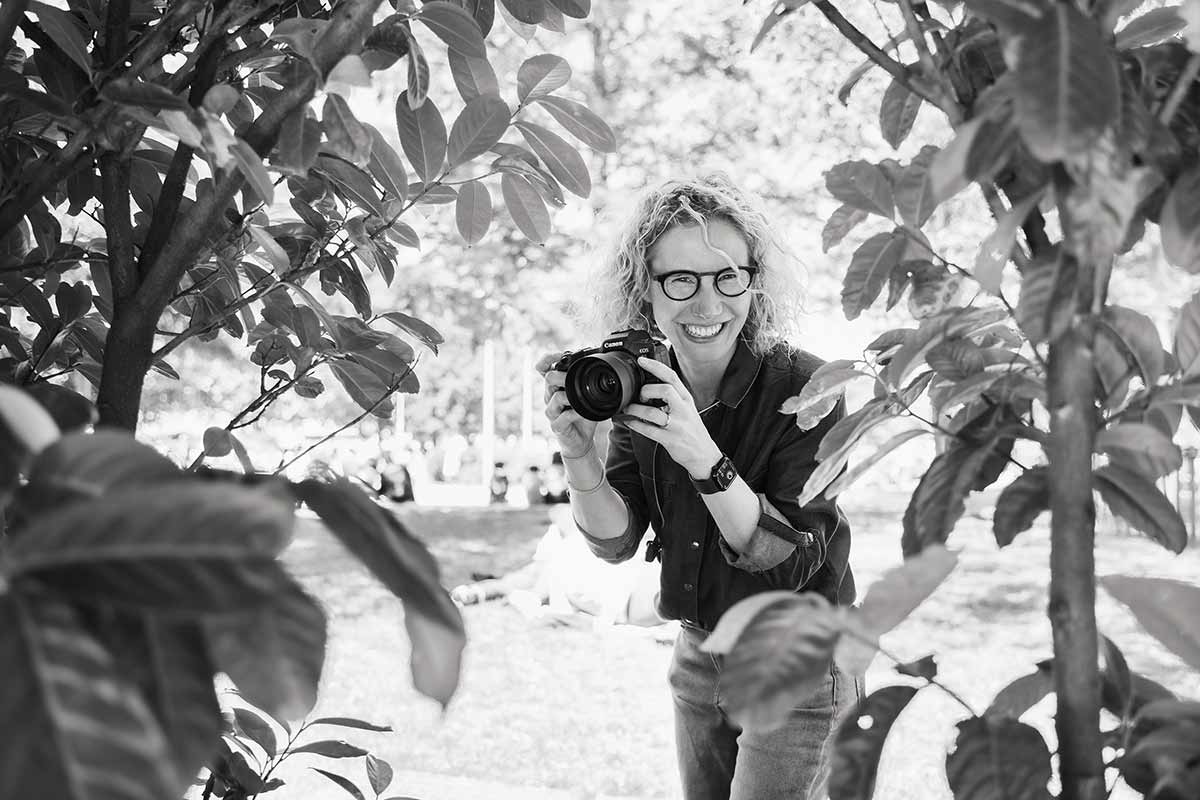
Welcome to my blog. I’m Helen Bartlett, a family photographer and a Canon Ambassador. I’ve been working as a professional children and family photographer since 2003. My photography takes me all over the world, capturing children and families enjoying their favourite things in their favourite places.
I specialise in black and white photography for its timeless feel, and I love creating unique images that delight my clients and keep them coming back year after year.
To create these images, I rely on having the best technology available to support my work. As a Canon Ambassador, I have access to the very best Canon cameras and lenses. While I have a regular kit that works perfectly for my style, it’s always fun to try new gear, step outside my comfort zone and see how some of Canon’s more specialist lenses perform in a family photography context.
Most of my work takes place in people’s homes or in outdoor locations they love, often parks or woods. To test the Canon RF 100-300mm f/2.8L IS USM, I did a couple of shoots in my local woods. I wanted to see how the lens performed in everyday situations and whether it would suit location-based family photographers.
As with all my gear reviews, including the Canon EOS R6 Mark III, Canon EOS R5 Mark II, Canon EOS R5 and the Canon EOS R, this won’t be a highly technical review. You can find those details on the Canon RF 100-300mm page on the Canon website. I’ll be sharing what it’s like to use this lens in real life, specifically for family photography.


Why I Chose to Test the Canon RF 100-300mm f/2.8L IS USM
I decided to test the Canon RF 100-300mm f/2.8L IS USM because I don’t own a fast zoom. I might be the only family photographer without a 70-200 mm in my kit bag.
When I moved to mirrorless and sold my DSLR and EF lenses, I went with the Canon RF100-500 mm f/4.5-7.1L IS USM lens instead of the Canon RF 70-200mm f2.8L USM. On the rare occasions I use a zoom lens, I thought the extra reach would be more useful than a fast aperture.
But I do miss having an f2.8 maximum aperture when working at the longer distances and wondered if the Canon RF 100-300mm f/2.8L IS USM could be the sweet spot between the two.

My Standard Equipment for Photographing Families
What made this so fun was how different it felt from my usual equipment. I’m a prime lens fan through and through. My go-to kit includes the Canon RF 35mm f/1.4 VCM, the Canon RF 50mm f/1.2L USM and Canon RF 85mm f/1.2L USM.
Many location-based family photographers favour zooms for their flexibility, especially the 70-200mm which is a firm favourite among my peers. For me, that focal length feels too long. I like to be close to the action, joining in with the games. So, using the Canon RF 100-300mm f/2.8L IS USM was a very different experience to the way that I usually approach photo sessions.
I enjoyed the challenge and gave it a proper test, photographing children in a setting that closely mirrors my regular work – a morning in the woods.

Handling and Size
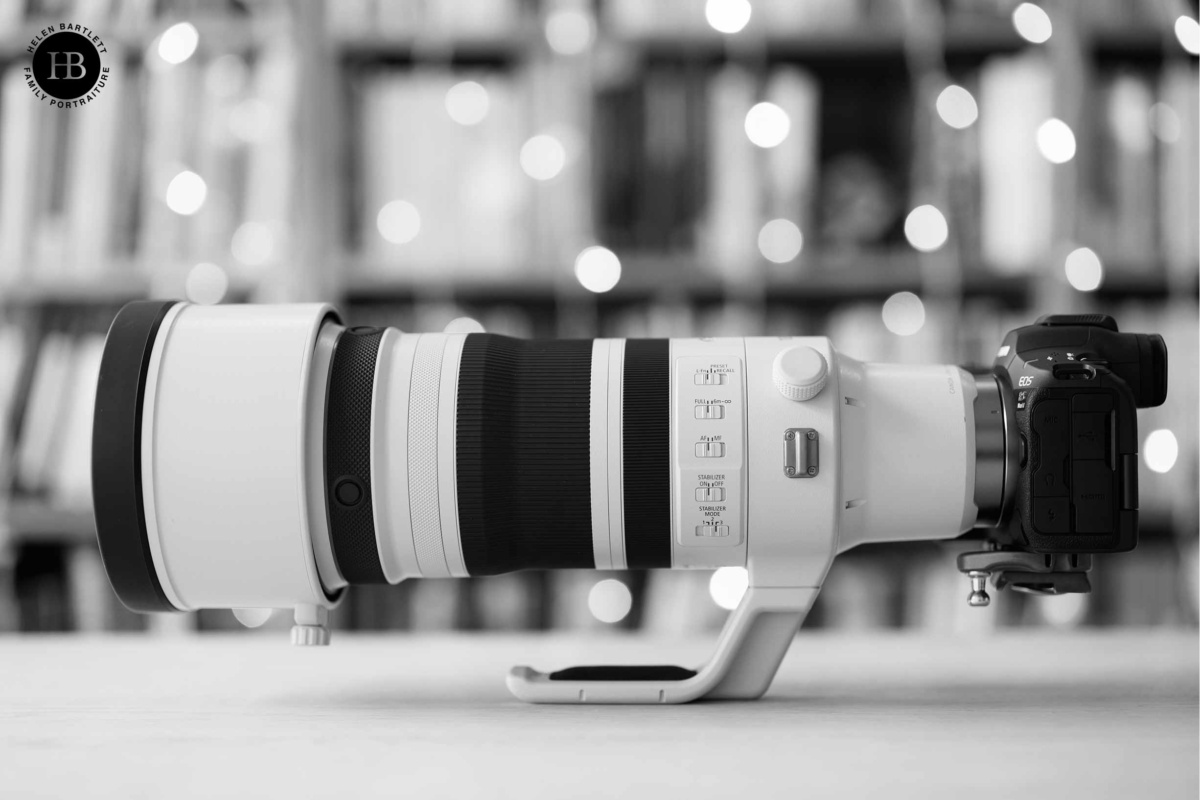
There’s no denying the Canon RF100-300 mm is a big lens. It weighs 2,585 g. I admit I was surprised when it arrived from Hireacamera – I expected it to be much smaller.
That said, I quickly got used to it. The tripod mount (which is fixed and can’t be removed) actually made it easier to carry. The strap attaches to the tripod collar rather than the camera body, which helps keep everything balanced and reduces pressure on your neck.
This size and weight is the trade-off for having a wide f2.8 aperture across such a long focal range. For the right jobs, it’s absolutely worth it. Canon have clearly put a lot of thought into making it as comfortable as possible to use.

Standing Out from the Crowd
The size of the lens made me more conspicuous than I expected. People noticed it – a lot. Several stopped to chat, which was lovely but a little distracting. The children I was photographing could also spot me more easily, which slightly ruined the game of hide and seek!
On the other hand, it certainly made me look professional. I could see how that could be an advantage in some settings.


The Lens in Use
The Canon RF 100-300mm f/2.8L IS USM is a joy to use. The zoom ring is large and well positioned, making it feel intuitive in the hand. Zooming from 100 to 300 mm is smooth and quick. I also appreciated that the zoom is internal so there isn’t the risk of getting water or dust in the mechanism.
It’s weather sealed too, which would be especially important if you were photographing at the beach – something I’d love to try. It would also suit wildlife, nature or sports photographers who are often out in less-than-perfect weather.
The control ring is standard for RF lenses and a really helpful addition, especially for those who’ve moved from EF lenses. It’s customisable – some photographers use it to control aperture. I have mine set to ISO, which I find really useful.
Many photographers might choose to use a monopod with a lens this size. I can see the benefit, but for family photography it’s not practical because I’m constantly on the move. Thankfully, the tripod collar rotates and locks every 90 degrees, so it’s quick and easy to switch between landscape and portrait formats without fiddling with screws.

Autofocus
As you’d expect from a lens designed for sport and press work, autofocus is excellent. Canon uses dual Nano USM motors to provide fast, accurate focusing.
Even with fast-moving children who dart about unpredictably, the lens tracked subjects easily on my Canon EOS R5 Mark II. I was working outdoors with background noise, but I didn’t hear anything from the motor – it’s very quiet.

Focus Pre-Set and Focus Limiting
The minimum focus distance is 180 cm, which I found tricky. I like to be close to my subjects and to chat as we play. For context, the Canon RF 85mm f/1.2L USM focuses at 85 cm and the Canon RF 50mm f/1.2L USM goes down to 40 cm which is so helpful when photographing kids who like to come really close to the camera.
If you usually photograph subjects from a distance, the lens includes a focus limiter that sets the minimum distance to 6 m. This stops the lens from hunting through the whole range and speeds up autofocus. I didn’t use it as I’m rarely more than a few metres away from my subjects but I could see that it would be helpful if you were photographing sports from the stands.
There’s also a focus pre-set button near the lens mount. You can pre-set a specific focus distance and instantly snap to it. I imagine this could be handy if you were photographing a race and wanted to jump between multiple points (e.g. the start line, and the finish) without missing a beat.

Stabilisation on the Canon RF 100-300mm f/2.8L IS USM
I assumed that holding a lens this large would make it tough to get sharp images, but stabilisation was outstanding.
The Canon RF 100-300mm offers up to six stops of optical image stabilisation when used with an EOS R series body that has in-body stabilisation – like my Canon EOS R5 Mark II.
I didn’t run specific tests to see how slow I could go, but pictures were sharp, even in dark woodland.
There are three IS modes:
– **Mode 1**: two-directional stabilisation for general use
– **Mode 2**: vertical stabilisation for panning
– **Mode 3**: stabilisation only during exposure, great for erratic subjects
I tried all three, initially switching between them depending on what I was doing. In the end, I settled on Mode 3 – it was one less thing to think about, and it worked brilliantly.

Image Quality
As expected from Canon, image quality was superb. Focus was sharp right to the edges. Paired with my EOS R5 Mark II, the results were stunning. I could easily produce prints up to 60 inches wide – which is the maximum size many of my clients choose for wall displays.

Getting in Close
This is a lens that grows on you. The more I used it, the more potential I saw. After writing this review I’m tempted to hire it again to try some things I missed.
Next time, I’d like to shoot more at 300 mm – especially with older children who are happy to follow direction. With younger kids, I tend to stay closer so I can help direct the games and keep the energy up. That meant I mostly used the wider end of the range, which isn’t really what the lens is made for.
When I did zoom right in, the results were lovely. Close portraits and parent-child interactions felt fresh and different to my usual work. Children are often very confident in front of the camera and happy to be close, but adults often prefer more personal space. This lens gave me the freedom to back off and still get tight compositions.

f2.8 and Beautiful Bokeh
The image quality of this lens is fantastic, and the bokeh is beautiful. With a 9-blade aperture, shooting wide open gives a wonderfully soft background. If you want to isolate your subject, this lens is a great choice.
I can see it being particularly popular with American photographers shooting senior portraits. The separation is gorgeous – subjects pop from the background in a way that feels almost three-dimensional. It’s a distinctive look that would help your work stand out.
I really enjoyed using the Canon RF 100-300mm f/2.8L IS USM and I’m thrilled with the images I captured. It’s a spectacular piece of glass.

Conclusion – Using the Canon RF 100-300mm f/2.8L IS USM for Family Photography
I really enjoyed using the Canon RF 100-300mm f/2.8L IS USM and I’m thrilled with the images I captured. It’s a spectacular piece of glass.
As with all short-term lens tests, I’ve thought of a dozen things I wish I’d tried. I’d love to see how it performs with the RF 1.4x or RF 2x extenders to explore the 200-600 mm range. That might be a project for another day. I’d also like to try using it with slower shutter speeds to introduce some motion blur. It’s always good to have ideas for next time.
Would I buy one? Not for my current work. It’s too big and draws too much attention in public spaces. Plus, we often walk 5km or more during a shoot, and this lens would be too heavy combined with a second camera and a wide-angle lens. It’s also very expensive, which reflects its exceptional design and build but as I would only use it occasionally it wouldn’t make sense for me.
But for someone working in a single location – perhaps an outdoor studio or on the beach – it could be incredible. I wish I’d had a chance to try it by the sea. I know it’s popular with sports and press photographers who want a fast maximum aperture, a flexible zoom range, and rock-solid build quality.
For the right person, the Canon RF 100-300mm f/2.8L IS USM is worth the price tag. I’m not that person, but I’ll definitely be hiring it again when the job calls for it. A brilliant tool and a fantastic addition to Canon’s RF lens line-up.
If you found this blog post useful and decide to buy a Canon RF 100-300mm f/2.8L IS USM then I have an affiliate link set up to WEX. Using my affiliate link will earn me a small commission at no extra cost to you. Your support is appreciated!
If you have any questions, please get in touch via email or send me a message on Instagram, I’m @helenbartlettphotography and I look forward to hearing from you.