The Best Lenses for Family Photography: A Guide

Welcome to my blog. I’m Helen, a family photographer for 23 years and a Canon Ambassador. Since I started my business, I’ve bought a lot of lenses. Many are the same focal lengths as those I started with – although updated with new technology. Others are new discoveries which I love and there are a few which sit on the shelf rarely used. Over the years I’ve streamlined my kitbag and I hire a lot of lenses now if I need something for a specific job. I’ve learnt a lot since I started my business in 2003 about what to look for in a lens, and particularly which are the best lenses for family photography.
Today I’m going to share that experience with you and hopefully help you to create the perfect lens line up.
(January 2026 – This article has been updated to reflect my move to the Canon mirrorless system using the RF lenses. Information on the EF lens range, compatible with Canons EOS DSLR cameras and with the EOS R range via an adaptor, has been retained alongside newer models as I know this blog is referenced by a wide range of photographers using the whole range of Canons cameras and lenses)

The Technical Terms for Describing Lenses: A Glossary
When you first enter the wonderful world of photography, the terminology can feel overwhelming. People talk of fast lenses and bokeh, tilt-shift and hyperfocal distance. It can be hard to keep up and work out what you need to know now and what you can learn later. I’ll start by running you through some of the basic terminology.
Fast lenses
These are lenses with the option to shoot at wide apertures. What is considered fast has changed over the years with advances in lens technology and, of course, one lens can be fast in comparison to another. For this guide, I’ll be talking about lenses with an aperture of f2.8 or above as fast. Very fast lenses, which I tend to use indoors, will allow me to shoot at f1.4 or f1.2. The widest aperture of a lens is described at the end of the lens name, e.g. the Canon RF 50mm f/1.2L USM has a maximum aperture of f1.2. Some zoom lenses have a variable maximum aperture such as the Canon EF 100-400 f/4.5-5.6L II which means that at 100mm the lens has a maximum aperture of f4.5 while at the longer 400mm length the maximum aperture is f5.6, i.e. the maximum aperture moves as you zoom the lens.
Lens mount
Lenses are designed to work with a specific camera system so a Canon lens won’t work on a Nikon body for example. Some third-party manufacturers such as Sigma and Tamron make lenses for different camera systems, but you always need to check that the lens you buy will fit the camera you own. There may also be adaptors available. For example you can use Canon’s EF lenses on its RF cameras with an adaptor but you can’t use RF lenses on EF cameras.
I shoot entirely with Canon lenses and am a Canon Ambassador so I’ll be referring to Canon lenses in this piece.
The RF or EF in the lens names refers to the lens mount on the two Canon EOS systems: RF refers to lenses that fit on the new mirrorless R-System cameras while EF lenses are on Canon’s traditional DSLRs.
As you will notice in this article, I talk about lenses with both the EF and RF lens mounts as I have shot professionally with both camera systems. Since 2020 I have been shooting entirely with mirrorless cameras – the previous seventeen years I shot with Canon DSLRs and the EF lens system.
Canon are bringing out more RF lenses all the time and this new lens line up is very exciting for us photographers as incredible technological advances bringing new opportunities for creative photography. Equally, many people are still working with DSLR cameras, and you can buy incredible EF lenses second hand so it’s worth considering some of these if your budge it tight.
Where you see USM this refers to the small motor built into the body of the lens and means the lens will focus faster than standard models.
IS stands for Image Stabilizer which means the lens has stabilisation built in.
STM stands for Stepper Motor Technology which means the motor in the lens is designed for quieter and smoother focusing which is particularly important for shooting video.
Prime lenses
A ‘prime lens’ is a lens that has a fixed focal length such as 35mm or 50mm. This is in contrast to zoom lenses that allow you to change the focal length, such as the 24-70mm or 70-200mm.
One of the benefits of prime lenses is that they’re usually faster than zooms (only the Canon RF 28-70mm f/2L USM has a maximum aperture faster than f2.8). Traditionally prime lenses were optically superior to zooms, although modern zooms are excellent.
Personally, I love to shoot with primes as I find them more instinctive to use than zooms. I don’t waste time tweaking my focal length. Instead I can quickly move, or ‘zoom with my feet’, to get the perfect angle.
Zoom lenses
Zoom lenses are designed to make life easier for us as photographers. We can change our angle of view without needing to change our lenses and so can move from a wide angle to a telephoto view in a matter of seconds.
The most common zoom lenses used by professional family and wedding photographers are the 15-35mm, the 24-70mm and the 70-200mm. These cover pretty much all eventualities but there are lots of different zooms on the market, from those aimed at travel photographers such as the Canon RF 24-240mm f/4-6.3 IS USM or the long lenses aimed at sports or wildlife work such as the Canon RF 100-500mm f/4.5-7.1L IS USM.
Wide angle and telephoto/long lenses
Lenses come in a huge variety of focal lengths from Canon’s EF 8-15mm f4L fisheye USM to the incredibly rare Canon EF 1200mm f5.6L USM lens which was on sale in 2014 for £99,000. Yes you read that correctly!
Different focal lengths give different perspectives to our pictures and can be used in different situations. With long lenses we can photograph things further away and they also compress perspective which can be very flattering in portraits. Wide angle lenses give us flexibility on our angle of view. We can fit so much in but we do need to be careful of distortion in the corners which can be an issue for family portraits.
The 50mm lens is close to what our eye naturally sees and is an excellent place to start. A 50mm is one of my favourite lenses and one of the best lenses for family photography.
Macro lenses
Macro lenses allow us to get really close to our subjects and take close-up images. Lenses that allow 1.0x or 1:1 magnification at their closest focus distances allow us to record the image onto our camera sensor at exactly the same size as it is in real life. This means that once we look at those images on our screens or enlarge them for print, the level of detail is phenomenal. Those amazing close-up shots of insects you’ve seen? They’re shot on macro lenses.
For family portrait photographers these come into play for taking detailed shots and are a great addition to any kit bag. Most newborn photographers will have a macro lens in their bag for taking pictures of delicate eyelashes and tiny toes.
My favourites are the Canon RF 100mm f/2.8 MACRO IS USM and also the wonderfully versatile Canon RF 35mm f/1.8 IS MACRO STM lens which works for macro but can just as easily take a family shot. It lives on my camera during newborn sessions and if I could only have one macro lens, it would definitely be the Canon RF 35mm f/1.8 IS Macro STM.
Bokeh
The dictionary definition of bokeh is ‘the visual quality of the out-of-focus areas of a photographic image, especially as rendered by a particular lens’. In layman’s terms, it’s how nice the background looks if you’re shooting at a wide aperture.
When you first start you won’t notice the difference in bokeh between lenses, or I didn’t anyway. But the further you go on your photographic journey the more this becomes important. Different lenses can have very different looks. My personal favourite lens is the Canon RF 50mm f/1.2L USM because of the glorious look to the bokeh. Camera manufacturers are aware of how important this is to photographers and so have found ways to make the bokeh even better, such as on the ground-breaking Canon RF 85mm f/1.2 L USM DS lens. Here, the DS refers to the defocus smoothing coating which makes the aperture even more creamy than normal. You can read more about that on the Canon blog.
So that’s a lot of information just to start with. The big question is, with all those options, what should we have in our bags, what are the best lenses for family photography?

The Canon EF 85mm f/1.4L IS USM has glorious bokeh.
The Best Lenses for Family Photography
When I’m heading out to photograph a family on a normal day I carry the following lenses: The Canon RF 50mm f/1.2L USM, the Canon 35mm f/1.4L VCM (a recent upgrade from the RF 35mm f/1.8 MACRO STM), the Canon RF 85mm f/1.2L USM and often now the Canon RF 24-105mm f/2.8L USM Z
I usually work with two cameras, both Canon EOS R5 Mark II which is a fantastic camera for family photography, and you can read more of my thoughts on the Canon EOS R5 Mark II and my other recent favourite the Canon EOS R6 Mark III which will suit those with slightly lower budgets who still want the best that modern technology can offer. On my two Canon EOS R5 Mark II cameras, I’ll tend to have a 35mm lens on one and either the 85mm or the 50mm on the other. Often it will be the 85mm outside or the 50mm indoors.
Why 85mm outside and 50mm inside? The 85mm gives me a bit more reach and kids run around a lot so I find that extra length helpful outside. But, inside there’s often less room to move around and so the 50mm is a better focal length giving me the option for both beautiful close-up portraits without distortion and also a wider view to include the environment of the family home.
But that’s not what I started with. When I initially set up my business my first lens purchases were the Canon EF 24-70 f/2.8L USM (the mark 1 version which I upgraded in the EF version before purchasing the RF version on my switch to mirrorless), the Canon EF 70-200mm f/2.8L USM and the Canon EF 50mm f/1.4 USM (which I have upgraded multiple times as you will read about below). Quite a different set up, so what’s changed?

Fast lenses such as the Canon EF 35mm f/1.4L USM II lens allow family photographs to be taken when there is very little light. This was shot at f1.8 1/80 at ISO 10,000
Primes vs zooms
The prime vs zoom debate is probably up there with RAW vs JPEG as something that divides photographers and, with both, there’s no right answer. It depends on your circumstances and personal preferences as to what will be the best lenses for family photography for you.
I like to shoot with prime lenses. I love to work with two bodies as I find this is more balanced and although it involves carrying more weight, it’s actually less strain on my back if it’s evenly distributed. Two bodies also mean I have a backup in my hand in case of disaster and, as a professional photographer, this reassurance is essential.
Working with two bodies means that shooting with two prime lenses works really well. I have my longer length lens (usually 50mm or 85mm in my right hand) and my wider lens (usually the 35mm in my left hand). Because I’m always set up that way round it means it’s incredibly instinctive to pick up the correct camera as a scene evolves in front of me. I use a Black-Rapid Double Breathe strap which I love.
Using fixed focal length lenses also means that over time I’ve got to know their angles of view incredibly well. If I need to shoot from the hip, or if I have my camera in a EWA-Marine bag for underwater work and can’t really see through the viewfinder, I can compose my image by instinct, knowing roughly what will be in the frame at any given time. This is a great skill to have as a photographer and one you won’t get using zoom lenses.
I also love the speed of prime lenses, the extra light entering the lens gives me more flexibility when I’m working indoors which happens a lot when I’m photographing families. I also love the look that portraits shot wide open at f1.4 or f1.2 have. It’s not easy shooting moving kids at those apertures but when you get it right the results are out of this world and advancing technology such as the incredible face and eye tracking on the Canon EOS R5 Mark II and EOS R6 Mark III are making this easier all the time.
This is not to say that I don’t have a place in my heart and my camera bag for zoom lenses. I will often use them if I’m travelling light and want to work with just one camera and one lens. If I’m going out with my family, I’ll either take the Canon RF 50mm f/1.2L USM or the Canon RF 24-105mm f/2.8L so I know I can cover most eventualities on a family day out. The Canon Canon RF 24-105mm f/2.8L USM Z is the most flexible lens I own.
My husband, a professional wedding photographer before he set up his company Light Blue Software (which provides business management software for professional photographers and is an invaluable resource for anyone setting up a family photography business) preferred to shoot with zooms. The flexibility and speed of changing angle of view appealed to him in the fast-paced parts of a wedding day.
It’s definitely a personal decision. Have a play with the different options and see which you prefer: there’s no right or wrong to the primes or zooms debate. Just be aware if you’re shooting indoors then primes will give you more flexibility in low light and for that reason makes them some of the best lenses for family photography.

Zooms are perfect when you don’t want to change lenses such as on a sandy beach. This was shot with the Canon EF 24-70mm f/2.8L II


The Canon RF 50mm f/1.2L is a sublime lens, my personal favourite of all the lenses I own.
The 50mm lens
I want to talk a bit more about the 50mm focal length as this is the length of lens that I most commonly recommend. Years ago, cameras would be sold with a 50mm ‘standard’ lens, now they tend to come with a zoom. The 50mm is the nearest we can get to the way our eye sees and so it’s a lovely comfortable focal length to work with. The great Henri Cartier Bresson shot most of his work on a 50mm lens.
My favourite lens to work with is the Canon RF 50mm f/1.2L USM because it’s so sharp, so fast, but also has such beautiful bokeh. Sometimes the sharpest lenses can have a very brittle feel to the bokeh so that’s something to look at when you’re choosing a 50mm. As mentioned before, the bokeh varies between lens models and between brands.
When I’m recommending a lens to beginners I go for the Canon RF 50mm f/1.8 STM for mirrorless or the Canon EF 50mm f/1.8 STM for DSLR users, the ‘nifty fifty’, which I believe is one of the best lenses that Canon make. The RF 50mm f/1.8 STM is affordable (it’s currently £184 on Wex), so it’s a brilliant place to start if you want to try a fast prime lens but don’t want to spend a lot of money. In comparison, the Canon RF 50mm f/1.2L USM is £2449. I know many professional photographers who shoot with the RF and EF 50mm f/1.8 STM and love it.
When we build our lens collections there’s a temptation to always go straight in at the top and buy the very best lenses for family photography. I’ve always believed it’s better to buy once and get the best I can afford than to buy cheap and buy twice. There’s also a good argument that lenses will retain their value much longer than cameras which are updated more quickly, so it’s better to invest in good glass rather than the fanciest camera. But, of course, it’s all budget-dependent and when we start out that budget is limited so it’s not sensible to get into debt to buy fancy lenses. We don’t need to spend £2000 on a lens until we know the lens will make that money back tenfold.
Over the last twenty-three years I’ve had four 50mm lenses. I started with the Canon EF 50mm f/1.4 USM lens which I had for years before I upgraded to the Canon EF 50mm f/1.2L USM. I had two copies of that lens, the first one was dropped on a concrete floor (there were tears) and I used the second copy until my move to mirrorless. Now I have the RF version which is utterly incredible and a huge step forward – it’s much sharper and much faster to focus. I bought the RF lens when I bought an EOS R as I’d used it when I was lucky enough to test it before it was launched. I fell in love with the lens there and then.
As I mentioned I now have the RF 50mm f/1.8 lens too, it’s nice to have a small light lens for family days out and I also believe that if I’m going to regularly recommend a piece of equipment, I need to like it enough to use it regularly myself.
Lenses get broken, they wear out, and their technology improves over the years. When you are starting out it can be tempting to jump straight in at the top but you can also work up to the very best lenses for family photography over time as your business evolves.
If you’re unsure about using prime lenses then start with the RF 50mm f/1.8 STM or the EF 50mm f/1.8 STM depending on your camera system. They are great lenses, cheap, and also a fantastic way to learn. I’ve always felt that prime lenses are a brilliant way to get your head around photography as there are fewer elements to think about compared to a zoom. And, importantly, the camera won’t be changing your aperture from one end to another as it would on a cheaper zoom lens. This can be very confusing when you’re starting out. Get an EF or an RF 50mm f/1.8 STM, you won’t be disappointed.

The 35mm lens
35mm has long been my favoured ‘wide angle’ lens and I’ve owned a variety of them over the years. I worked through the EF 35mm f1.4 lenses having the first and second version of that brilliant lens. Then, when I moved to mirrorless I bought the wonderful – and extremely competitively priced – RF 35mm f1.8 MACRO STM and then last year I purchased the faster and sharper RF 35mm f/1.8L VCM.
When I’m talking to photographers who are just moving to mirrorless then the RF 35mm f/1.8 Macro tends to be top of my recommendation list. It’s small, light, sharp and cheap and the macro capability means it’s extraordinary versatile. This is often the lens I’ll take if I’m going on holiday as it covers all my bases.
I love this lens for newborn sessions as I am able to take family pictures and details just by moving myself around a room. The quality is incredible for the price and a few years ago Canon enlarged one of my images taken on this lens to 2m across for display at Photokina – a trade fair in Germany – and the eyelashes on the sleeping baby girl were sharp as a tack.
In 2025 I upgraded for slightly faster autofocus and the better optical quality of the new Canon RF 35mm f/1.4L VCM . With lenses you do get what you pay for, and I like to have the very best equipment available when working for my clients. I made this change because I could afford to though, not because I needed to and I do miss the flexibility of having the macro element to this lens. Both lenses are fantastic, if you are deciding between the two perhaps think about how much you will use the macro element when making your decision. For UK photographers then Canon’s test drive service allows us to borrow some of these lenses free of charge so we can test them in real world situations and make informed decisions on which lenses will be right for us.
My favourite zoom – Canon RF 24-105mm f/2.8L USM Z
As a self-proclaimed ‘prime girl’ it has surprised me that I’m adding section on a specific zoom lens to this revamped blog post. But, in 2025 I bought the first zoom that I fell in love with. Previous to this I have used zooms for particularly situations – beaches where I don’t want to change lenses, boats where I need to be further away and wanted the longer reach. I have a RF 24-70mm f/2.8L USM which I used if I needed flexibility while also travelling light but it was always a lens that I never really loved. I found the 70mm end a touch too short – I was used to the longer reach of the RF 85mm f/1.2L which is one of my favourite lenses. I found the f/2.8 aperture a little too slow compared to my beloved 50mm f/1.2. Of course, no lens will be all things to all people and the 24-70mm is a great and versatile option and the favourite lens of many of my professional photographer friends, but it didn’t’ quite hit the spot for me. It just goes to show how personal these decisions are.
So, I’m not quite sure what temped me to purchase a Canon RF 24-105mm f/2.8L USM Z one summer evening in 2025. Possibly being in the middle of a long season of photo shoots I just fancied something different and so it was on a whim that I put it in my online shopping basket. But what a fantastic whim it turned out to be. Much to my surprise I really fell in love with this lens. If I could only have one zoom lens it would be this one. My favourite lens remains the RF 50mm f/1.2L USM. I can’t imagine ever swapping primes for zooms as my main workhorses, but this is a very versatile lens that is brilliant for family photographers.
The 24-105mm length range covers pretty much all bases for family photography – 24mm is wide enough to photograph indoors in quite confined spaces without too much distortion. It’s also wide enough to include buildings and architecture when telling stories out and about. The f/2.8 isn’t ideal for indoor work where light is often limited and a fast aperture of f/1.4 or f/1.2 is better on a winter day. However, combined with some lighting such as an LED panel or a flash on a dark January morning, or just by itself on a bright sunny day – you will have enough flexibility to photograph children jumping on the bed at a very useable ISO.
Outside is where this lens really comes into its own as the extra length means you can be a little slower on your feet and still keep up with active little ones. Tight headshots are available to you just a twist away from a full length shot and there are also fun effects such as zoom bursts which can really liven up a photo shoot – personally I love them when kids are playing tennis. It’s a lens that encourages experimentation and creativity and I’ve been blown away by the quality of the files; it’s optically a superb lens.
The minimum focus distance on this lens is what really sets it apart for me – it’s a tight 0.45m all the way through the focal length range (compared to my RF 85mm f1.2 L which is 0.85m). I find this so helpful when photographing children as they tend to run up really close to the camera and it also allows for some interesting compositions, getting in really close for a different type of portrait. Different lenses allow us think differently and so, even if you aren’t in the market for buying a selection it can be worth hiring a lens or maybe doing a lens swap with a trusted friend from time to time to boost your creativity.
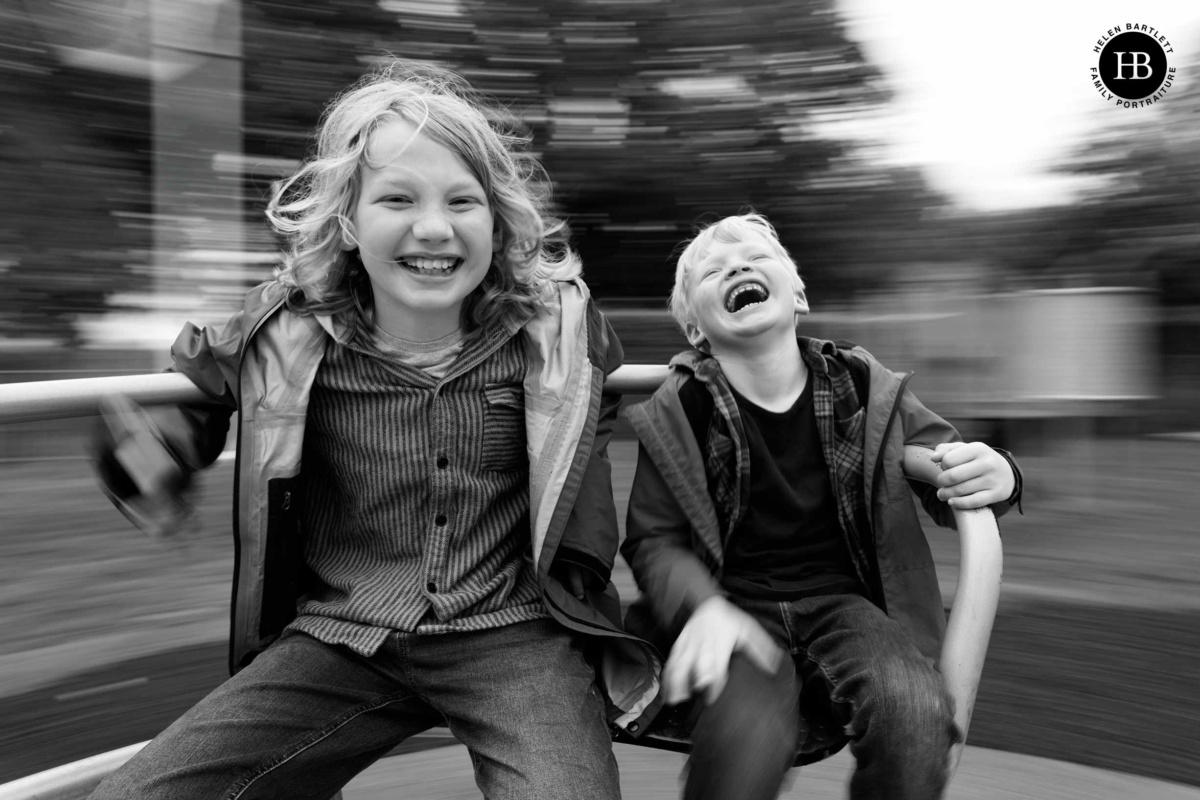

Tilt-Shift lenses add a unique feel to images such as this newborn and family photograph shot on the Canon TS-E 45mm f2.8 lens
Speciality Lenses for Family Portraits
While I work mainly with my three prime lenses and the RF 24-105mm f/2.8L zoom, I do have a selection of more specialist lenses which I use for different situations.
Long telephoto zooms
When I first started out – and I believe this is common among family photographers – I used the Canon EF 70-200mm f/2.8L USM a lot. It’s an easy lens to get great results with and produces pictures with a beautiful compressed perspective: pictures that are very different to the types of images your clients will be producing with their phones.
If I look at pictures of family photography training days that appear on my Instagram feed, then the majority of photographers have a 70-200mm lens on their cameras. And a lot of those close-up head and shoulders portraits of children I see on friends’ feeds are taken with this long zoom lens.
It’s a very useful lens. However, as my photography journey has progressed, I used it less and less. In fact, when I moved completely to mirrorless in 2020 I didn’t replace it in my kit bag. I had found the minimum focus distance of 1.2m just too far, I didn’t feel I could be really communicating at that distance. It wasn’t a lens that really suited my style of working – 1.2 metres is a long way away when having a conversation with a three year old.
I want to be able to chat quietly to my subjects rather than having to shout instructions from way back. I believe the best expressions, especially from children, are when they can see and hear you easily and when they regard you as a friend to play with rather than a stranger with a camera. I also find that personally I’m more lazy when I shoot with a long zoom. There’s a tendency to stay in one place and pick pictures off rather than move myself around searching for the best angles and most innovative composition.
Instead of the EF 70-200 I bought a Canon RF 100-500mm f/4.5-7.1L IS USM which I use for situations where I need distance like the edge of the sea, children horse-riding, or waterskiing. I use it enough to make it worth the purchase although if I was just working in people’s homes, gardens and local parks I wouldn’t use it so much.
As I have mentioned on this blog I do occasionally hire lenses and in 2025 I hired the Canon RF 100-300mm f/2.8 L IS USM for a few weeks to have a play. You can read about using the Canon RF 100-300mm f2.8L for family portraits. It’s a stunning lens but at the end of the day I found it much too big and too expensive for the amount I would use it and, while it will be a fabulous lens for some photographers, it’s not one that I would regularly recommend to family photographers.
Super wide lenses
I don’t use super wide-angle lenses for portraits very often. While it can be fun to get in close and include a lot of elements in the story, I tend of find that the distortion often leads to unflattering pictures. There are exceptions to the rule however and situations where a super wide-angle lens allows for really creative pictures and a unique angle that wows my clients. For this purpose I exchanged the EF 15mm f/2.8 Fisheye and the Canon EF 16-35mm f2.8L II USM which I used in my DSLR days, for an RF 16mm f/2.8 STM. This is a fantastic little lens – it’s absolutely tiny weighing 165g and measuring just 40.2mm, it easily fits in a coat pocket. It’s not my sharpest lens – I wouldn’t expect it to be for £287, but for me the size and convenience easily makes up for that. The much bigger and much shaper RF 15-35mm f2.8L IS USM lens would come in at £2399. For some photographers that would be a great purchase, and if you enjoy working at really wide angles it would definitely be worth a look but for me, the 16mm does the job very well at a fraction of the price.
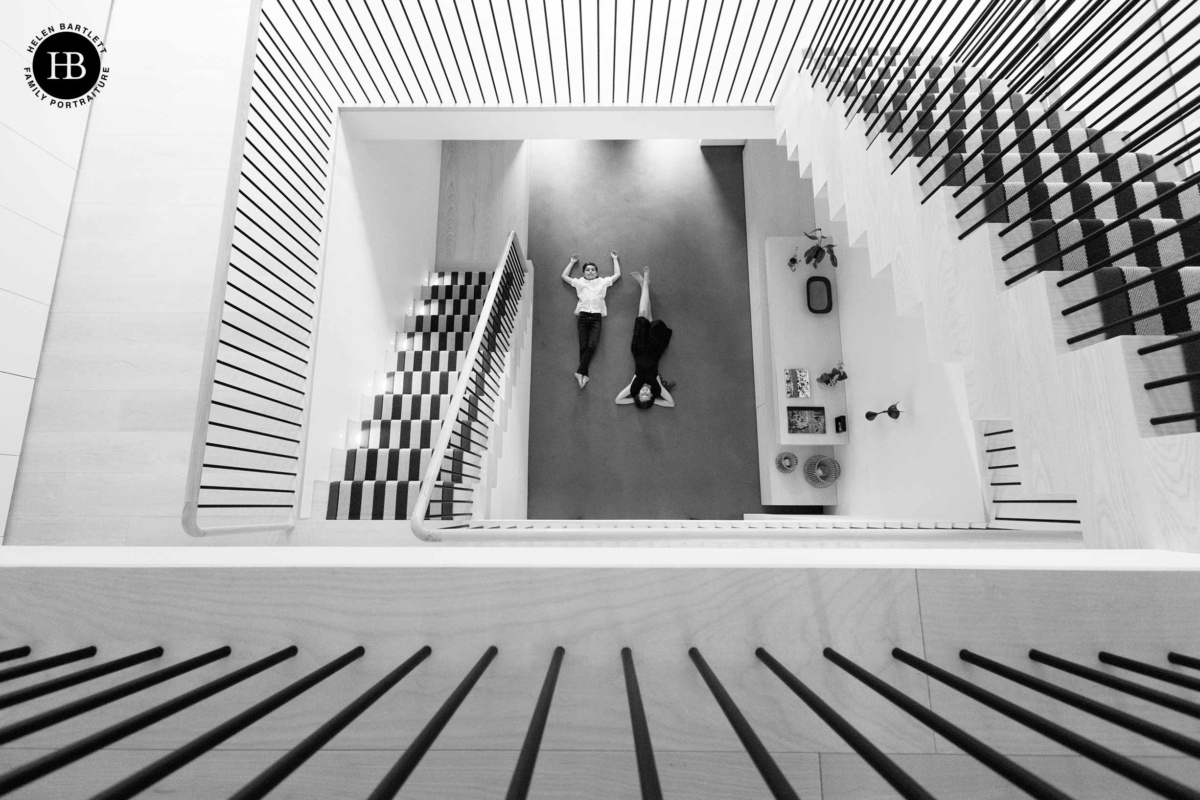
Tilt-shift lenses
Tilt-shift lenses are mainly the preserve of landscape and architectural photographers, but they can be used by portrait photographers to create a really lovely and very unusual look to pictures. I’ve written a blog post about using tilt-shift lenses for portrait photography. I use my Canon TS-E 45mm f/2.8 on newborn shoots occasionally as I love the way it blurs the image and allows me to shift the plain of focus creatively to produce images unlike anything my clients have seen before.
Any of these lenses that give a very specific look to your pictures, like a fisheye or a tilt-shift, need to be used in moderation. Quirky pictures can become clichés very quickly and you don’t want your images to date badly. Timelessness is critical for my family photography because I want the children to love the images as adults, so any special effects achieved with lenses should be used with caution.

Longer lenses such as the Canon EF 70-200mm f2.8L USM are perfect when you don’t want to get too close to the action.
The Benefits of Swapping Between Lenses
One of the things I enjoy most about having a wider selection of lenses is that it gives me the opportunity to push myself, to bounce myself out of a creative rut and to mix it up in my work. I owe it to my clients to always be pushing myself forward, always striving for better and more interesting work. I find having a selection of different focal length lenses is great for this.
Sometimes I’ll switch between working with primes and working with zooms for a month or so just for variety, to sharpen my brain and simply just for fun. Having a new piece of equipment is exciting. I’ll borrow or hire lenses for a couple of shoots and see how I get on. This can be a fantastic way to try new ideas without investing in the full cost of a new lens.
Try a shoot with just one camera and one lens (with a back-up in your bag just in case of course) but see how it forces you to think more creatively, I recorded a video for Canon’s YouTube on the subject of One camera, One lens. Often limiting our options is exactly what we need to make us more experimental. Use a prime if you normally use a zoom or vice versa, hire a tilt-shift or a very long lens and have a play. There’s so much fun to be had and, over time, you’ll learn which lenses suit your way of working and how you see the world.
So what are the best lenses for family photography? For me it would be the primes. The RF 50mm f/1.2 L USM, the RF 35mm f/1.4 L VCM the RF 85mm f/1.2 L USM and the Canon RF 24-105 f/2.8L IS USM Z – with my speciality favourites being the Canon RF 100mm f/2.8L MACRO IS USM, the Canon RF 100-500mm f/4.5-7/1L IS USM and the RF 16mm f/2.8 ST. For you it might be the zooms or a different set of focal lengths, there is no right or wrong. Try different things and find out what works for you.
If I’ve just bought a Canon mirrorless camera and am looking for my first prime I’d also consider the RF 35mm f/1.8 MACRO IS STM, a fantastically versatile lens and wonderful for the price.
If you wanted a zoom my top pick would be the Canon RF 24-105 f/2.8L IS USM Z.
If I could only have one lens forever it would be the Canon RF 50mm f1.2L USM and I urge you to try a 50mm lens to enjoy the flexibility that a fast prime lens can bring. Start with the RF on mirrorless or the EF on a DSLR, get the cheap 50mm f/1.8 STM and see where the journey takes you.
Enjoy photographing your families whether that’s professionally or just for fun. It really is the most fun you can have with a camera.
I hope this guide to the best lenses for family photography has been useful. If you have any questions do ping me an email or connect with me on Instagram and we can go forward on this journey of family photography together.